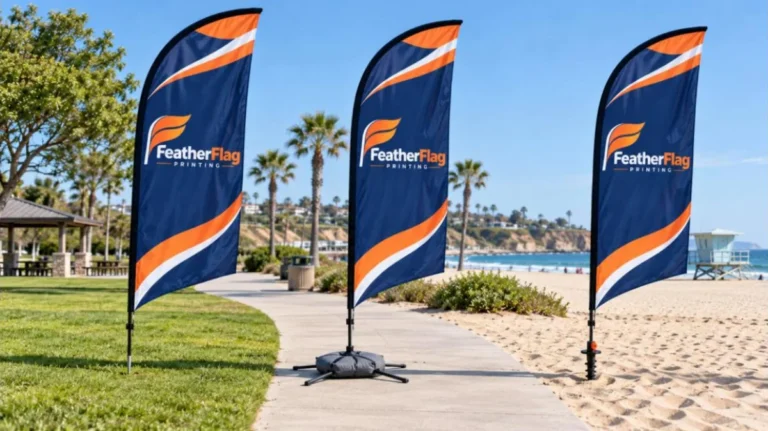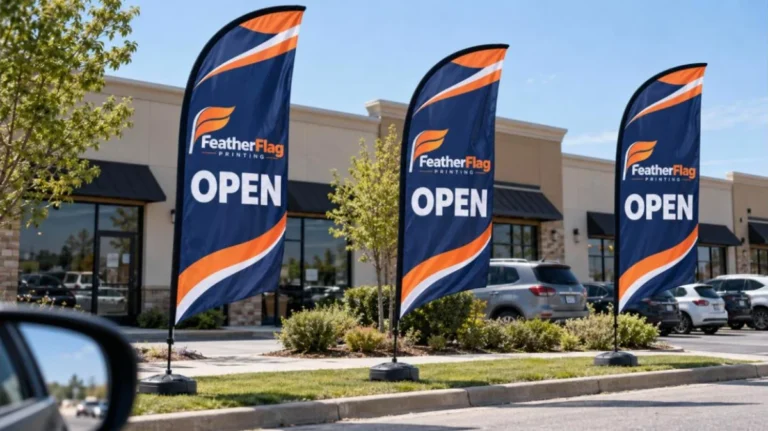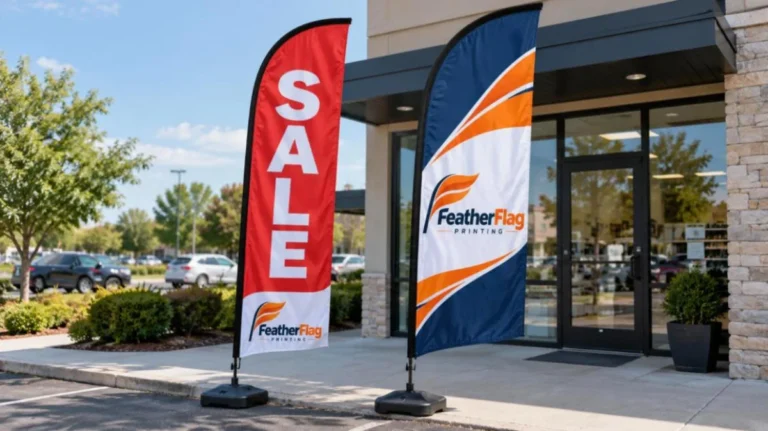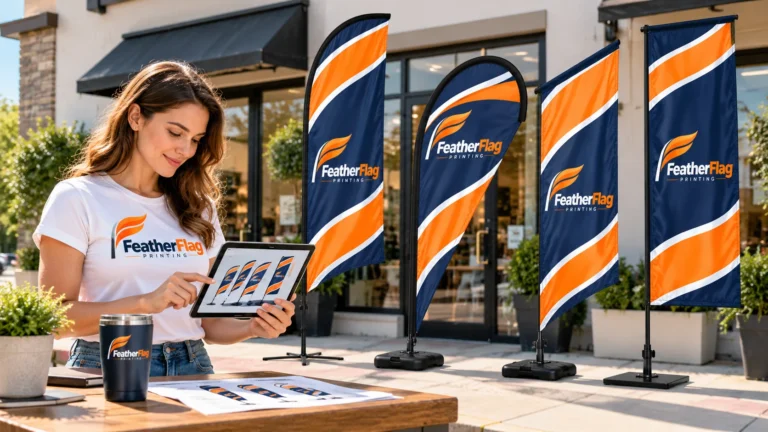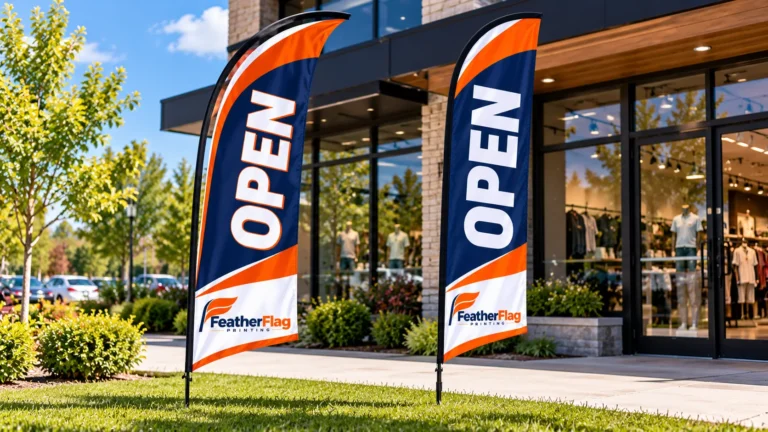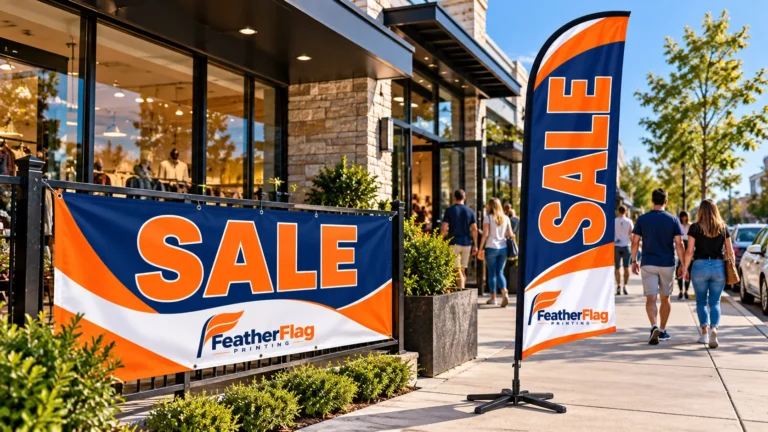
A feather flag may look like one simple advertising display, but several parts work together to create its shape, movement, and stability. From the printed fabric to the flexible pole and the base underneath it, every component has a specific job.
Whether you are buying a new flag, replacing a damaged part, or simply trying to understand how these displays work, knowing the basic components makes it easier to choose the right setup.
So, What Are the Main Parts of a Feather Flag?
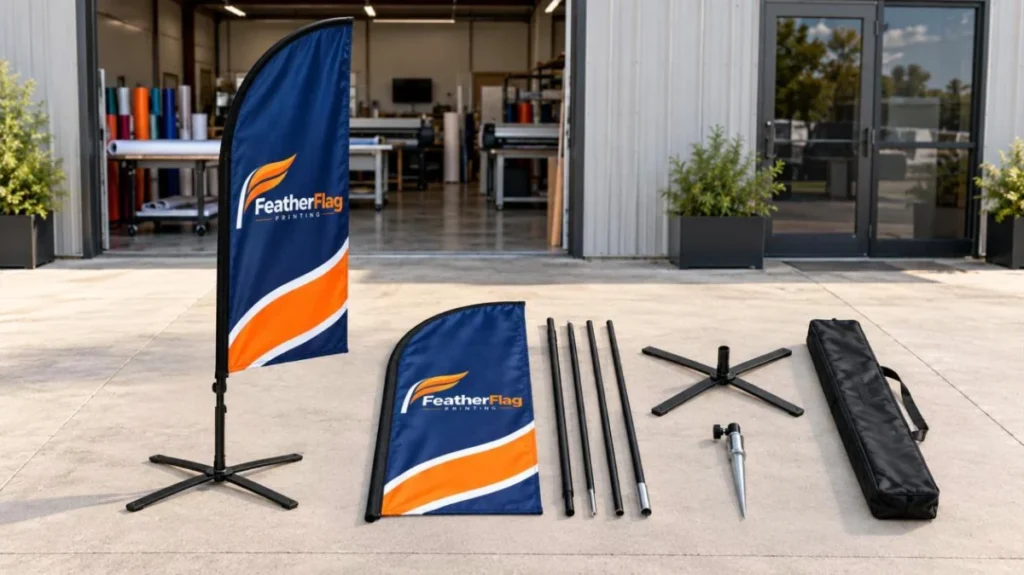
A feather flag is made up of several key components: the fabric panel, flexible pole, pole sleeve, attachment points, connectors, and base. Each has a different role, but they are designed to work together as one display.
| Part | What It Does |
|---|---|
| Fabric panel | Displays the logo, artwork, or message |
| Flexible pole | Supports the fabric and creates its curved profile |
| Pole sleeve | Holds the pole along the fabric edge |
| Attachment points | Keep the fabric positioned correctly |
| Pole connectors | Join individual pole sections |
| Base | Connects the display to the ground or floor |
Most complete kits also include multiple pole sections and may come with a carrying bag.
- Fabric panelDisplays your logo, artwork or message
- Flexible poleSupports the fabric and creates the curved shape
- Pole sleeveHolds the pole along the edge of the fabric
- Attachment pointsClips or cords keep the fabric in position
- Pole connectorsJoin the separate pole sections together
- BaseConnects the flag to the ground or floor
The Fabric Panel Carries Your Message
The fabric panel is the main printed part of the flag. It carries your business name, logo, promotion, event message, or other artwork.
Its shape is specifically cut for the feather flag structure. Rather than hanging loosely from a straight pole, the fabric follows the flexible support to create the characteristic curved profile.
Polyester is commonly used because it provides a lightweight material that works well for fabric printing and outdoor displays.
The Flexible Pole Creates the Signature Shape
The pole gives the flag its structure.
Unlike a completely rigid sign support, a feather flag pole is designed to flex. This allows it to follow the curved edge of the fabric while keeping the display upright.
Most systems use several pole sections that connect together during setup. Once separated, the pieces are easier to transport and store.
What Is the Pole Sleeve?
The pole sleeve is the fabric channel through which the supporting pole passes.
It helps position the fabric along the pole and allows the panel to follow the intended shape. The sleeve is normally attached along one edge of the flag and remains part of the fabric panel.
Because it experiences movement during setup and use, the sleeve and its stitching are important parts of the flag’s construction.
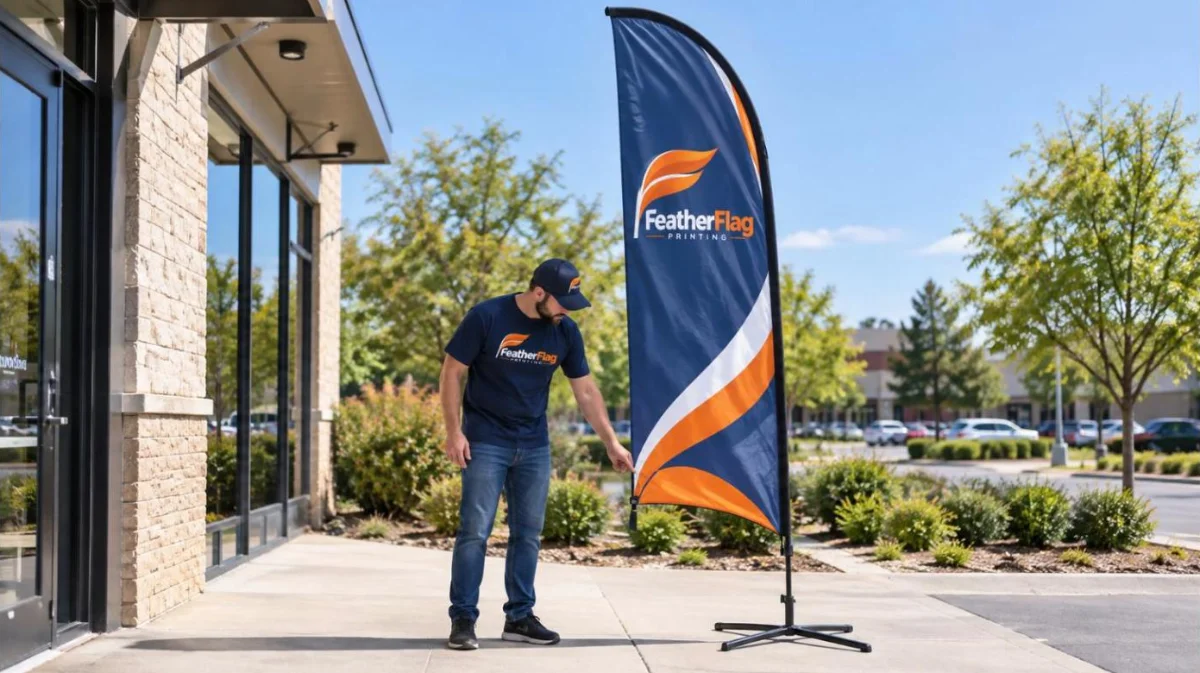
The Small Attachments That Keep the Fabric in Place
Feather flags can use different attachment methods depending on their design.
Loops, tabs, clips, cords, or similar fittings may help secure the fabric to the pole or keep specific areas aligned.
These pieces are small, but they help the panel maintain its intended position. If you ever need replacement hardware, make sure it is compatible with your particular flag system.
Why Are Feather Flag Poles Made in Sections?
A full height pole would be difficult to transport and store.
Breaking the pole into smaller sections makes the entire display more practical. The sections can be connected during setup and separated when the flag is packed away.
This design can also make repairs easier. If one compatible section becomes damaged, it may be possible to replace that section instead of the complete pole.
The Base Determines Where Your Flag Can Stand
The base provides the connection between the pole and the surface underneath it.
The right choice depends on where you plan to install the flag. A soft outdoor surface can accommodate a ground spike, while concrete, pavement, and indoor floors usually require a base that sits on top of the surface.
If you are choosing a complete setup, browse our custom feather flags and the available base options to find a configuration suited to your installation.
Ground Spikes for Grass and Soil
A ground spike is designed for suitable soft ground such as grass or soil. It is inserted into the surface and provides below ground support for the pole.
This type of base is useful for outdoor locations where the ground can safely accommodate a spike.
Cross Bases for Hard Surfaces
A cross base sits on top of a hard surface rather than being inserted into it.
Its arms create a supporting footprint around the bottom of the pole. Depending on the design and conditions, additional weight may be used to improve stability.
Weighted and Water Filled Bases
Weighted bases add mass at the bottom of the display, making them useful for locations where a ground spike cannot be used.
Water filled bases provide a more portable option. They can be transported empty, filled at the installation site, and emptied again when the display needs to be moved.
For outdoor installations, match the ground stake or base option to the surface and flag size.
Wheel and Indoor Bases
Wheel bases are designed for locations where the flag needs to be repositioned regularly. Instead of lifting the entire display, the unit can be moved using its wheels.
Indoor bases are designed for finished floors where ground spikes are unsuitable. They can be useful for exhibitions, showrooms, reception areas, and indoor events.
What Is a Feather Flag Made Of?
Different components use different materials because each part has a different job.
| Component | Common Material | Purpose |
|---|---|---|
| Flag fabric | Polyester | Provides the printed display |
| Pole | Fiberglass or flexible composite | Supports and shapes the flag |
| Sleeve | Polyester fabric | Holds the pole in position |
| Base | Metal, plastic, composite, or combination | Provides stability |
The exact materials vary between manufacturers and product ranges, so individual specifications are more useful than assuming every feather flag is constructed in exactly the same way.
Why Does a Feather Flag Look Like a Feather?
The name comes from the flag’s distinctive profile.
The fabric follows a flexible, curved support rather than hanging from a straight horizontal pole. This creates a long curved edge and a flowing shape that resembles a feather.
The final appearance comes from the relationship between the fabric cut, pole flexibility, and attachment system.
Is a Feather Flag Called Anything Else?
You may come across terms such as feather banner, swooper flag, or windless flag when searching for similar displays.
These terms are not always used consistently. Products with similar names can have different shapes, pole systems, or mounting methods.
When comparing products, look at the actual construction and dimensions rather than relying only on the name.
How Feather Flags Differ From Other Flag Styles
Feather flags are sometimes compared with teardrop flags, sail flags, and traditional flags because all can be used as portable displays.
The main difference is the shape and support system. Feather flags have a narrower, curved profile, while teardrop flags have a fuller tapered shape. Sail styles generally offer a broader flowing profile. Traditional flags usually hang from a more conventional pole arrangement.
If you want a detailed comparison, see our Feather Flag vs Teardrop Flag guide for a closer look at the differences.
How Big Is a Standard Feather Flag?
There is no single universal size for every feather flag.
Manufacturers usually offer several height and width options, allowing buyers to choose a display that fits the available space and viewing distance.
Before choosing a size, consider where the flag will stand, how far away viewers will be, and whether surrounding buildings, signs, trees, or other displays could affect its placement.
For more detailed guidance, see our size buying guide.
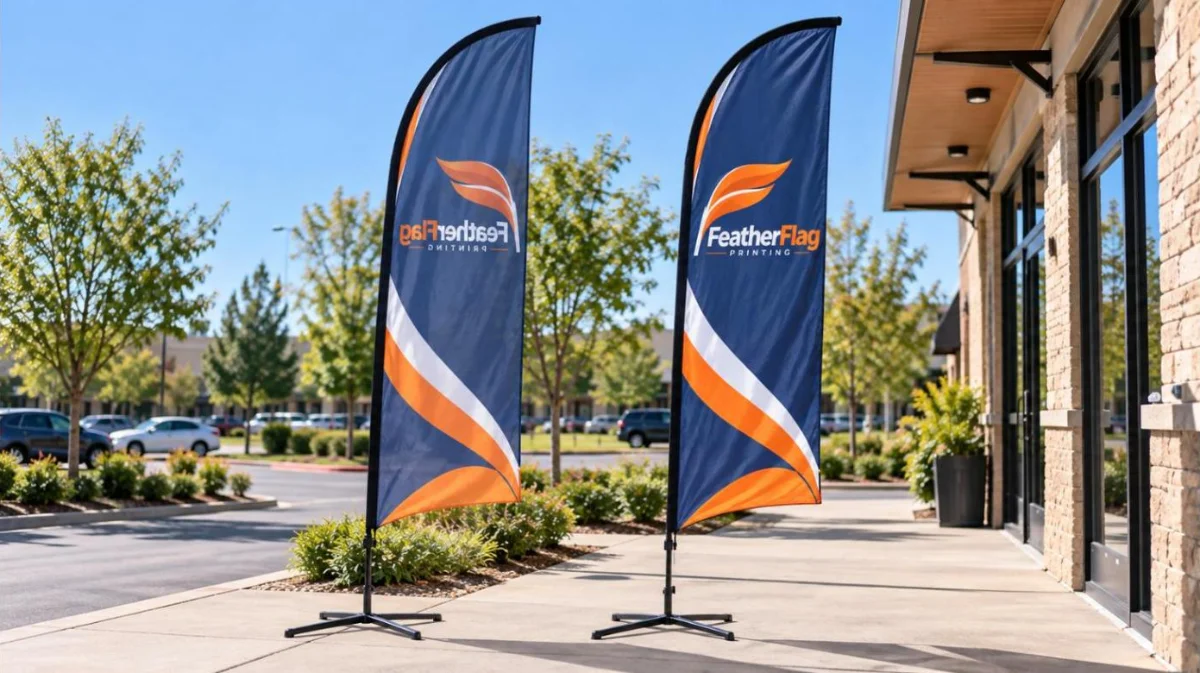
Single Sided or Double Sided?
The right printing configuration depends on how people will approach the flag.
| Feature | Single Sided | Double Sided |
|---|---|---|
| Printed surfaces | One | Two |
| Artwork | One design | Same or different designs |
| Construction | Simpler | More layered |
| Best suited to | One main viewing direction | Viewing from multiple directions |
If the flag will be viewed mainly from one direction, single sided printing may be sufficient. When both sides need to communicate clearly, double sided construction may be worth considering.
How Feather Flag Printing Works
Dye sublimation is a common printing method for fabric flags.
Heat is used to transfer dye into the fabric, creating a lightweight printed panel that remains flexible. The final result depends on more than the printing method alone. Fabric quality, artwork, color preparation, equipment, and production standards all contribute to the finished appearance.
What Does Your Artwork Need?
Good artwork starts with the right file.
Vector formats such as AI, EPS, and SVG can be enlarged without losing the clean edges needed for large format printing.
RGB is mainly associated with digital screens, while CMYK is commonly used in print production. Pantone references can also help communicate specific brand colors when accurate color matching matters.
If you are supplying a logo for a custom flag, the original high quality artwork is preferable to a small image copied from a website.
How the Complete Flag Works as One System
Each component has a specific responsibility.
The fabric provides the visible message. The sleeve and attachments keep it positioned. The pole sections and connectors create the flexible structure, while the base connects everything to the installation surface.
This is why compatibility matters when replacing a component. A part that looks similar may not necessarily work with another flag system.
How to Assemble a Feather Flag
Setting up a feather flag is simple when each component is in the correct position.
- Lay out the partsFabric, pole sections, fittings and base
- Connect the polePush each section fully into place
- Add the fabricGuide the pole through the sleeve
- Secure fittingsAttach the loops, clips or cords
- Attach the baseSpike for soft ground, base for hard floors
- Stand it upLet the pole form its curve
- Final checkJoints, sleeve, clips and base
Step 1: Lay Out the Components
Place the fabric, pole sections, connectors, attachment hardware, and base together. Check that all required parts are available before starting.
Step 2: Connect the Pole Sections
Join the pole sections in the correct order. Push each connection fully into place and make sure the sections are secure.
Step 3: Position the Fabric
Locate the pole sleeve along the fabric. Carefully guide the assembled pole through the sleeve according to the manufacturer’s instructions.
Step 4: Secure the Flag
Attach any loops, clips, cords, or other fittings provided with the flag. Check that the fabric sits naturally along the pole.
Step 5: Attach the Pole to the Base
Connect the bottom of the pole to the selected base. Use a ground spike for suitable soft ground or an appropriate surface mounted base for hard floors.
Step 6: Stand the Flag Upright
Position the base securely and allow the flexible pole to form its intended curve. Check that the fabric is sitting correctly.
Step 7: Give It a Final Check
Inspect the pole connections, sleeve, attachment points, and base before leaving the flag in place. Make sure the complete setup is secure and suitable for the conditions.
What Keeps a Feather Flag Standing?
The pole and base work together to support the display.
The flexible pole creates the structure and holds the fabric in its intended profile. The base provides the connection to the ground or floor and must be appropriate for the installation surface.
Flag size, base type, surface conditions, and the surrounding environment can all affect stability. Always follow the manufacturer’s setup recommendations.
How Does a Feather Flag Handle Wind?
A feather flag is designed to move with airflow rather than act like a rigid sign.
The flexible pole allows the fabric to move while maintaining its general profile. However, wind performance depends on the complete setup, including the flag size, pole, fabric, base, surface, and weather conditions.
No feather flag should be assumed to be suitable for every weather condition. Follow the manufacturer’s guidance and take the display down when conditions become unsuitable.
How Long Can a Feather Flag Last?
A feather flag does not have one fixed lifespan that applies to every situation.
Where and how often
- How often it is used
- Sunlight
- Wind
- Rain
How it is made
- Fabric quality
- Stitching
- Printing
How it is treated
- Handling
- Storage
How long it remains in good condition depends on factors such as frequency of use, sunlight, wind, rain, handling, fabric quality, stitching, printing, and storage.
A flag used occasionally in moderate conditions will generally experience a different level of wear from one that remains outdoors every day.
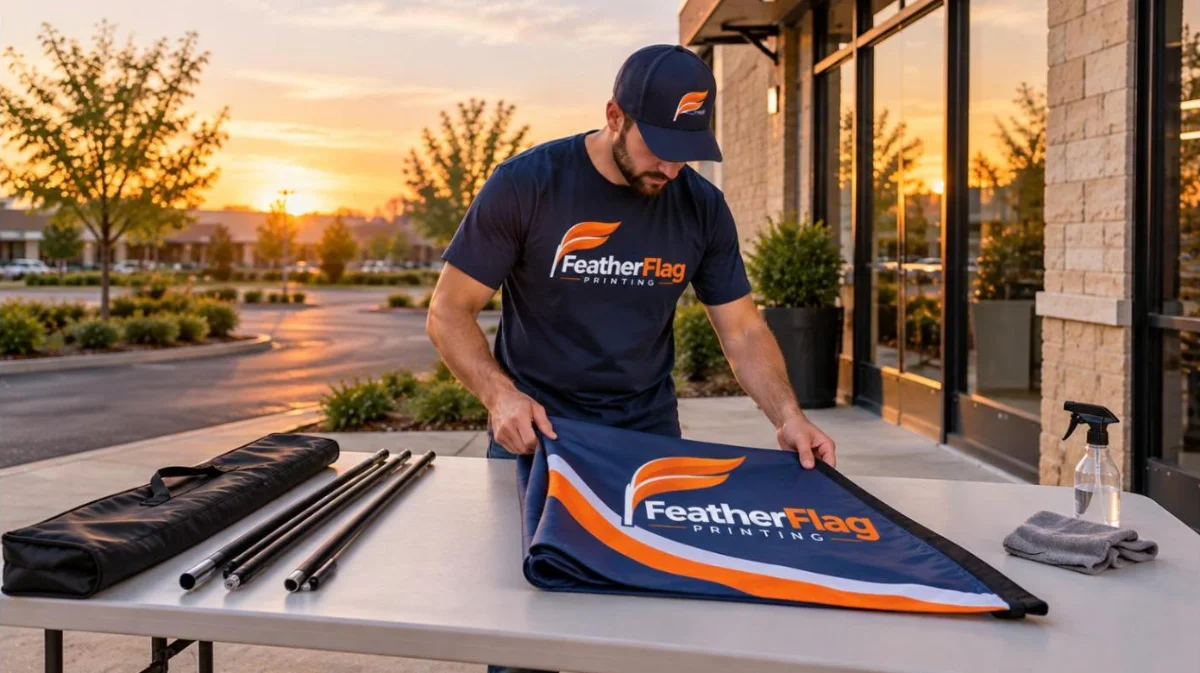
Simple Care Can Protect the Display
Good storage and basic maintenance can help preserve the flag.
Follow the manufacturer’s cleaning instructions and avoid harsh treatments that could damage the fabric or print. If the flag becomes wet, let it dry completely before folding it away.
It is also worth checking the sleeve, stitching, pole sections, connectors, and base periodically. Taking the display down during unsuitable weather can also reduce unnecessary wear.
What Comes in a Complete Feather Flag Kit?
A complete kit may include most or all of the components needed for setup.
| Component | Purpose |
|---|---|
| Printed flag | Carries the artwork |
| Pole sections | Create the supporting structure |
| Connectors | Join pole sections |
| Base | Supports the display |
| Attachment hardware | Secures the fabric |
| Carrying bag | Helps with transport and storage |
The exact contents vary between configurations. Always check the product options before ordering so you know which components are included.
Where Can Feather Flags Be Used?
Feather flags are suitable for many temporary and semi permanent display locations.
Businesses can use them outside retail stores, restaurants, dealerships, offices, and property locations. They can also be used at trade shows, festivals, sporting events, grand openings, markets, and community events.
The key is choosing a flag size and base that suit the specific location.
Feather Flag Terms You Should Know
| Term | Simple Meaning |
|---|---|
| Feather flag | Curved fabric display supported by a flexible pole |
| Feather banner | Alternative term used for some feather style displays |
| Swooper flag | Term sometimes used for similar curved flags |
| Windless flag | Term used by some suppliers for similar displays |
| Flag panel | Main printed fabric |
| Pole sleeve | Fabric channel that holds the pole |
| Pole section | Individual piece of the supporting pole |
| Pole connector | Part that joins pole sections |
| Ground spike | Base for suitable soft ground |
| Cross base | Surface mounted support with crossing arms |
| Weighted base | Base designed to add stabilizing mass |
| Water filled base | Base that gains weight when filled |
| Wheel base | Base with wheels for easier movement |
| Single sided | Printed on one side |
| Double sided | Printed on two viewing surfaces |
| GSM | Measurement of fabric weight |
| Dye sublimation | Heat based fabric printing process |
| Vector artwork | Scalable artwork that remains sharp when enlarged |
What Should You Check Before Buying?
Understanding the components makes it easier to compare complete feather flag systems.
Start with where the flag will be installed. The surface determines which base options are suitable. Next, consider the available space and viewing distance when selecting the size.
Then look at the fabric, pole construction, printing configuration, artwork requirements, and included hardware. If you need a complete setup, compare our feather flags and compatible bases rather than selecting the fabric alone.
The best setup is the one that matches the location, message, size requirements, and way you plan to use the display.
The Simple Way to Understand a Feather Flag
A feather flag becomes much easier to understand when you look at it as a complete system rather than a single piece of fabric.
The fabric carries the message. The pole creates the shape. The sleeve and attachments position the fabric. The connectors join the pole sections. The base supports the complete display.
Once you know what each part does, it becomes easier to choose the right size, base, printing option, and replacement components for your setup.